Categories
Technical

Rennes, a Model City for Transport Data

Having had some issues with obtaining the bike share data for some cities, it was refreshing to receive an email from some developers in Rennes, NW France, detailing the public API for transport data that the city has made available, under a Creative Commons-style licence for reuse. You have to sign up for an API key, through their data website, and then all the data you need is available, quickly and with documentation, through XML or other popular machine-readable formats. As well as the bike-share data, metro line information, including alerts, is also available.

Why can’t all cities be like this?

Picture by Eun Byeol Lee on Flickr

Categories
Data Graphics Mashups Technical

Fewer Cities, More Cities

Some bad news and good news about the Bike Share visualisation.

The bad news – the operator behind the schemes in Paris, Seville, Vienna, Dublin, Brussels, Valencia and Toyama asked me to stop getting the current bike share data from their websites. Although I was just loading their webpages, “in practice you are extracting data from [the operator’s] databases and re-utilising it” and “[the] databases are protected under the harmonised sui generis database right, as provided under Directive 96/9/EC: chapter III article 7 (1) and (2).”

For these seven cities, you can still see a historical snapshot from last Monday, when the feeds were switched off, but not the live status, historical animation or trend graphs.

This is despite a quick search on the web revealing a six-month collection of data for one of the schemes (at four minute intervals), the resulting trends being shown at a conference; a better-service campaign website, again for one of the schemes, with regularly updated performance tables; and an iPhone app pulling in the data from numerous schemes run by the operator, amongst others.

Digital Urban also mentioned this in the context of Bike-o-Meter, which uses the aggregated data from my Bike Share maps.

Now for the good news – I’ve added in five more cities – Rennes, Bordeaux, Zaragoza, Mexico City and Rio de Janerio. Yay! The inclusion of Mexico City and Rio should hopefully counter some claims of an European/English-speaking bias! Mexico City’s scheme appears to be concentrated in one very affluent district of the metropolis, while Rio’s is based on the seafront south of the city, rather than in the main urban area.

Rennes is a particularly interesting example, more about that shortly.

[Update – turns out I’m not the first.]

Categories
Conferences Data Graphics

Visualising Bike Share

Here’s the presentation that I gave at the #geomob London Geo-mobile developers meetup at UCL last night.

[slideshare id=5528647&doc=visualisingbikeshare-101022061626-phpapp01 width=”590″ height=”480″]

Please note the data presented is preliminary and unreviewed and should therefore not be considered to be definitive or necessarily correct.

Categories
Data Graphics

Real Life Tweet-o-Meters

I was at the British Library yesterday for the launch of the Growing Knowledge exhibition of innovative research techniques. One installation has been built by Steve and Ben at CASA and is a real-life version of the Tweet-o-Meters (which were also the inspiration and technology for the Bike-o-Meters I mentioned yesterday.)

The installation has dials for nine cities around the world, showing the current level of Twitter activity (i.e. geo-located tweets) in these locations.

I love the “1930s retro” design of the installation. It is notable that all the other installations in the exhibition involve computer screens, in several cases these are used to display old maps (e.g. the New York Public Library rectification service) or historical paintings (using a Microsoft Surface screen.) I love the irony that the exhibition that is showing the data right now, i.e. coming live off Twitter from around the world, is the one which doesn’t involve any computer screens at all – although they are of course computer-controlled behind the scenes.

There’s something wonderfully organic about seeing the needles go ricochetting off the ends of the dials, as sudden bursts of tweets from a particular city come in. I hope the distinctly analogue technology survives. I think we get the work when the exhibition closes next summer. I’m pretty sure, when Steve’s not looking, it will be quite straightforward to “retro-fit” it for a physical monitor of bike share schemes. 😉

Steve has posted some more pictures from the exhibition, including some behind-the-scenes shots.

Categories
Data Graphics Mashups

Dials and Levers Overload

Steve, here in the lab at CASA, has adapted his popular Tweet-O-Meter display of Twitter activity in cities around the world, for my bike hire maps, to create Bike-O-Meter. Now, on a single screen, you can see lots of Google-powered gauges, showing how busy the bike share schemes around the world are right now. Some show massive spikes during their rush hours, while others are more popular at weekends. Most dials will move every two minutes, a few (the Velib ones) update every 10 or 20 minutes.

At the time of writing, the bike share schemes of the Spanish cities, particularly Barcelona, Girona and Valencia, are the ones being most actively used. Spanish rush-hours at lunchtimes seem generally to be as big as the morning/evening ones! Biking home for the siesta?

There’s a second mode, accessed here, that shows how unbalanced the schemes are – high values indicate that a lot of the bikes are concentrated in one part of the city, and there’s a lot of empty docking stations in another part. The metric is the percentage of bikes that would need to be moved to balance out the docking stations across the city.

Thanks Steve for making this awesome visualisation!

Categories
Leisure OpenStreetMap

Nike Grid is Back

Nike’s alternative reality game/metrogaine/street-o – Nike Grid – is coming back to the streets of London. This time it’s over two weeks rather than just a weekend, and involves an element of teamplay – you can join a team based on your London quadrant (N, E, S or W) or university, or an adhoc one.

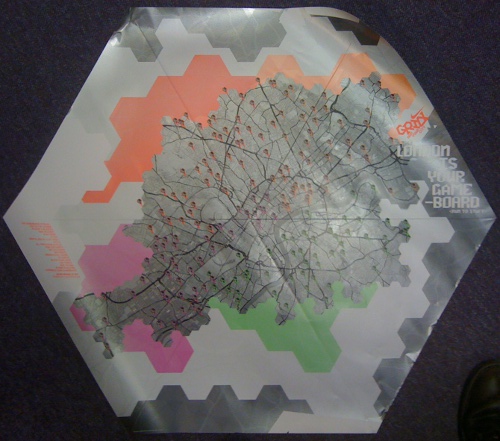
Of note, the map in the player pack is a rather nice (I think) restyled silver-and-black version of the green-and-black fold-out maps used in the original game. The source data is OpenStreetMap and the cartography reminds me somewhat of 8-Bit City – it’s not particularly useful for precision navigation, but is a nice example of Boing-Boing cartography, to borrow an expression from a talk at the recent Society of Cartographers conference. Oh, and they have credited OpenStreetMap contributors this time – yay!

Categories
Data Graphics

Girona’s Commuters the Perfect Bike Hire Users?

An interesting pattern spotted on the bike hires this morning – I’m not reading too much into it as obviously Girona’s scheme is far smaller than London’s, but it appears that Girona’s commuters this morning managed to almost perfectly distribute the bikes around the town – a marked constrast to London’s who bunch them all in the City and the West End after each morning commute. Either that, or no one’s using them at all in Girona and the redistribution vehicle got to work very efficiently.

The key measure is the grey graph – this shows the number of bikes that would need to be moved to another dock, in order for all the docks to have same proportion of full and empty slots, i.e. a perfectly balanced system.

Girona at 10:50 BST (11:50 local time):

London at 10:50 local time:

The drop in the imbalance figure in Girona started at about 9am local time – London’s rise started at about 8am local time.

Categories
Orienteering

Urban Orienteering this Year

The Warwick Town Race was the final urban orienteering race in this year’s Nopesport Urban League, so I thought I would recap the six urban races I enjoyed the most this year – most of them Urban League but with some non-league ones too:

Best 6:
6. Nottingham
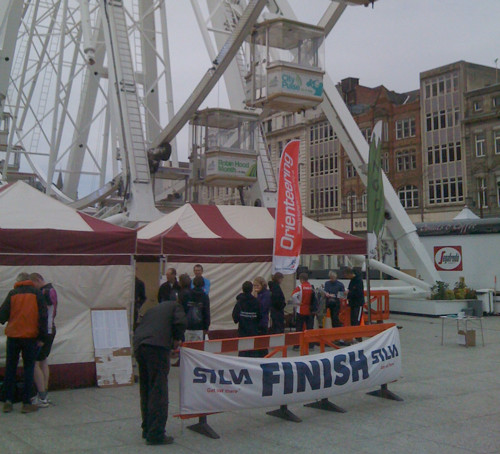
I had been meaning to visit Nottingham for ages, and enjoyed this great city centre race, which included the ceremonial Park Estate, an interesting leg up and through the castle complex, and a start/finish in the city’s central square, right underneath a big wheel!

5. Carlisle
A bit of a trek to get to this one, but it was worth the effort, as excellent course planning took us on the sights and included some classic route choice legs, a shopping-centre control near the end, a maze control, and, like Nottingham, a start and finish right in the main town square – excellent for promoting the sport!

4. Lincoln
My third outing here for an urban race, and finally the event is getting the numbers and recognition it deserves. We didn’t get to go in the castle this time, or the city walls or university campus, but instead, like Carlisle, we got a maze control, and a good mix between modern urban areas and the historic centre. Lincoln is one of my favourite orienteering cities and on my must-do list.

3. Didcot
An unexpected delight – the make was entirely in a Milton Keynes-esque housing estate with wiggly roads and unanticipated barriers. Some excellent planning kept the technicality going all the way around. I fell into numerous route traps.
2. Edinburgh
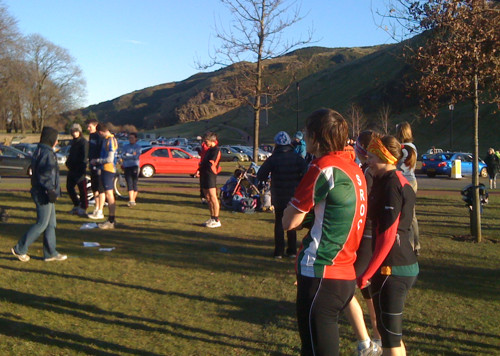
This race is always very early in the year, so is chilly, but the weather was once again sunny. This year’s courses didn’t focus so heavily on the intricate Royal Mile, housing estate and university areas, but the less technical focus was more than made up by the spectacular views on Calton Hill, a section through Princes Street gardens, and some spectacular leg choices including a possible route right through the city station.
1. City of London
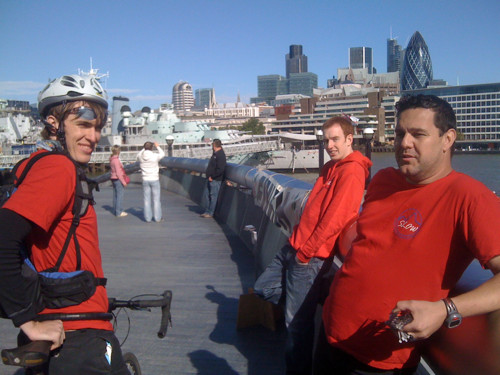
A bit cheeky perhaps to put the race I founded and my club organises at No. 1, but this year’s was even better than the first two years. We had a huge turnout – over 700 running on the day – and the race also got the club together spectacularly, running the show smoothly on the day. With Alan as Race Director and Matthais Mahr (of Venice Street Race fame) as the Course Designer this year, the courses and situations were both superb – the weather being perfect, for the third time in a row, also helped. The second half of the courses were in Bankside and Bermondsey, which meant crowds of passers-by were encountered by the competitors – not something experienced in the City proper at the weekend. Next year’s race is already in the planning and will hopefully be even bigger and better.

Cities that I most want to run an urban race in:

  • Bristol
  • Bath
  • St Albans (happening in 2011!)
Categories
London

Three-Dimensional Estate Map

I spotted this rather fantastic estate map in Chislehurst, while heading to the Bromley parkrun on Saturday morning:

Categories
Mashups

Bike Hire Around the World

My map/visualisation of the Boris Bikes – the London cycle hire scheme – is now available for four eight fifteen more cities. The complete list:

Paris has so many docking stations that many browsers and computers will struggle to show everything – although the site and animations work very well in Webkit-based web browsers such as Apple’s Safari and Google’s Chrome. The maps are all at approximately* the same scale.

Montreal’s scheme is similar to London’s – indeed the underlying technology (Bixi) is the same and in fact the London system was bought in from Montreal. Paris’s scheme (Vélib) is quite different and, because a separate webpage has to be loaded for each one of the 1200 docking stations, the map only updates once every 20 minutes. Seville and Brussels also use Vélib and update once every 10 minutes, while Montreal, along with Denver, Girona, London, Washington DC and Melbourne, update every two minutes.

More cities to follow soon!

* There is a slight difference in scale depending on the latitude of the city, the difference equal to the difference in the cosines of the respective latitudes.