Categories
Orienteering

Where in Britain are the Orienteering Races?

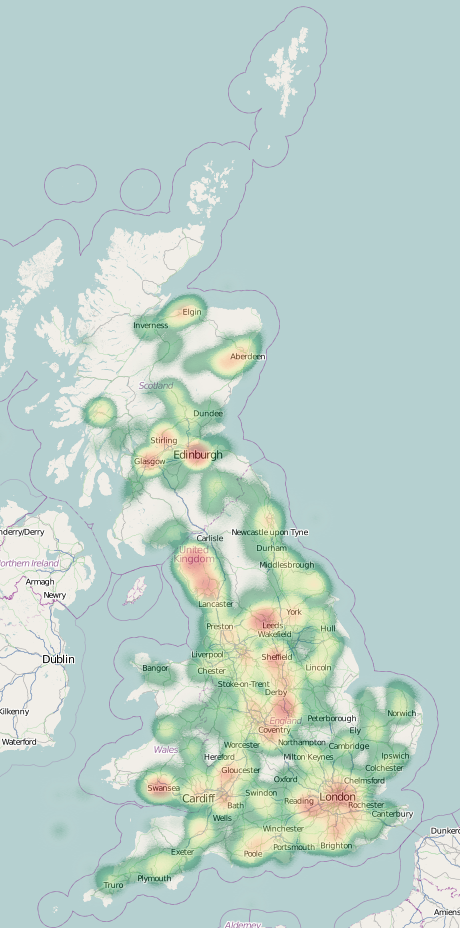
As a Saturday-lunchtime project, I have created a heatmap of where the 2700-odd geolocated orienteering races have been held in Great Britain in the last two years.

As you would expect, clusters appear around the main urban areas, where the population sizes supply participation for many local events being put on. Another major bright-spot is the Lake District, generally recognised to be the finest orienteering area in England. Other areas, such as the Cotswolds NW of Oxford, seem to be somewhat underused.

If you have a browser than can handle the HTML5 Canvas tag (i.e. not Internet Explorer!) you can view the heatmap here. Zoom into your local town or city to see if events have been held there – when zooming in, you’ll need to adjust the two sliders most of the way to the right, so that individual events show up. With the individual settings, a single, isolated event will have very little impact on the heatmap.

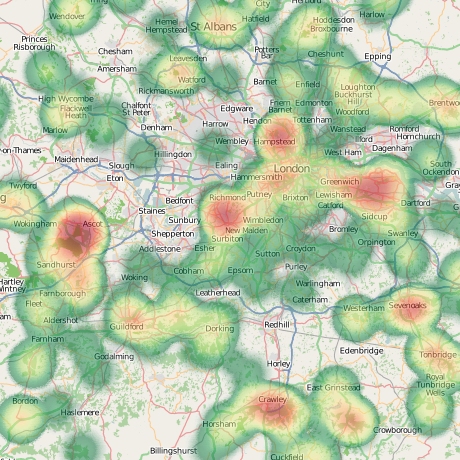
A look at the London area:

The heatmap was possible thanks to the excellent Heatmap library produced for OpenLayers by Bjoern Hoehrmann. The map is powered by OpenLayers, with an OpenStreetMap basemap. I’ve used a custom colour ramp, based on one supplied by Colorbrewer. The custom map adornments are supplied by MapBox.

Categories
Bike Share London

The Most Popular Bike Share Routes in London

Following on from my map of all the first million or so bike routes, Here are the most popular bike share routes in London, based on flow data for August, September and October 2010.

Weekdays – the map below shows where there were more than 200 journeys (in either direction) in the weekdays during the period. The line thickness grows by one pixel for each 100 journeys:

Flows here are dominated by commuters going to/from King’s Cross station to Bloomsbury, and Waterloo and London Bridge stations to the City. A short hop to Notting Hill Gate station, in the far west of the scheme, is also popular, as is the Broad Walk route through Kensington Gardens.

The top 5 weekday journeys are:

  • Finsbury Circus, Liverpool Street Newgate Street, St. Paul’s
  • Queen Street, Bank Concert Hall Approach 2, South Bank
  • Turquoise Island, Notting Hill Notting Hill Gate Station, Notting Hill
  • Lexham Gardens, Kensington Wright’s Lane, Kensington
  • Holborn Circus, Holborn Concert Hall Approach 2, South Bank

Weekends – the map below shows where there were more than 50 journeys in total (in either direction) in the weekends during the period. The line thickness grows by one pixel for each 50 journeys:

The parks – Hyde Park and Regent’s Park in particular – are much more popular at the weekends, as is Angel and London Bridge. Docks around the British Museum and the Museum of London are also popular. The City itself is, as expected, virtually dead at weekends for Bike Share users.

The top 5 weekend journeys are:

  • Black Lion Gate, Kensington Gardens Palace Gate, Kensington Gardens
  • Hyde Park Corner, Hyde Park Black Lion Gate, Kensington Gardens
  • Warwick Avenue Station, Maida Vale Clifton Road, Maida Vale
  • Turquoise Island, Notting Hill Notting Hill Gate Station, Notting Hill
  • Westbourne Grove, Bayswater Turquoise Island, Notting Hill
Categories
Bike Share Data Graphics London Mashups OpenLayers

The First Million London Bike Share Journeys

Thanks to a FOI request from Adrian Short, Transport for London have recently released to their developers area details of 1.4 million bike share journeys. The data is believed to include all the journeys between 30 July 2010 and 3 November 2010, except those starting between midnight and 6am.

I’ve created a map which visualises these journeys – select a docking station and a time, and it will show the journeys that start/end at that dock, depending on the options chosen.

You can see the map here. On launching the site, an initial docking station – one outside Waterloo station – is selected, and an “interesting” timeframe is chosen – the morning of 4 October, which was a day impacted by a tube strike.

Heavy usage along the Broad Walk through Kensington Gardens, particularly at weekends:

The predominant flows from a docking station near King’s Cross station, in weekday mornings, are outwards (red lines), particularly south towards the river. Only a few inbound journeys happen (blue lines):

The reverse is true in weekday evenings, as commuters head back to the stations:

The map bears a resemblance to my live Barclays Cycle Hire scheme status map, as I’m reusing a lot of the same code and graphics.

Categories
Orienteering

UK Orienteering Fixtures Map – New Version

Cross-posted from my research blog.
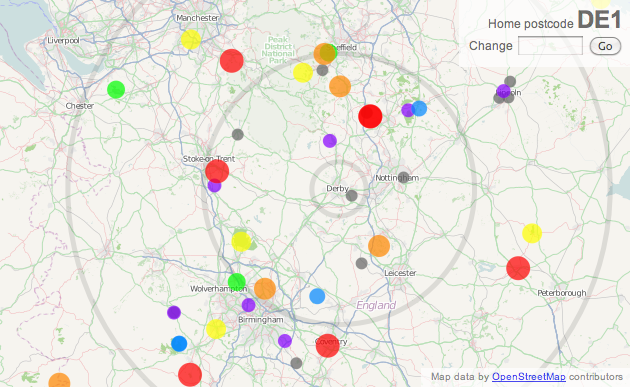
Five years ago, I created a mashup of forthcoming orienteering fixtures in Great Britain, as listed by the sport’s national governing body, British Orienteering, on its website. It was based on the Google Maps v2 API, and a regular scraping of the HTML on their website, and was a set of pins on a map, coloured by the number of weeks to the event. On clicking a pin, you got a popup balloon with details of the event, and a link to the organising club’s website. A postcode locator, based on data from the NPEMap project, was added, so you could focus on events in your local area. You could also filter out far away events.

A couple of years later, British Orienteering’s web developers added their own map to their website – Google Maps v2 API based, with pins coloured by the number of weeks to the event, and a popup balloon, a postcode search and distance filter etc etc… The Unique Selling Point of my fixtures map was lost.

So, when a rewrite of British Orienteering’s website just before Christmas broke my map, I took the opportunity to rewrite it, as a vacation project, using the technologies I’ve been using a lot in 2010 – namely OpenLayers, OpenStreetMap, OS OpenData and coloured vector circles. The map is bigger, brighter, and hopefully more useable than the official map and my previous version.

You can see the new map here – with a mass of dots representing forthcoming fixtures, and circles surrounding the “home” postcode, backed by OpenStreetMap, with the postcode locator based on CodePoint Open from Ordnance Survey OpenData. Only the locator uses a database, the rest of the webpage is constructed on-the-fly from a webpage regularly copied from the British Orienteering website.
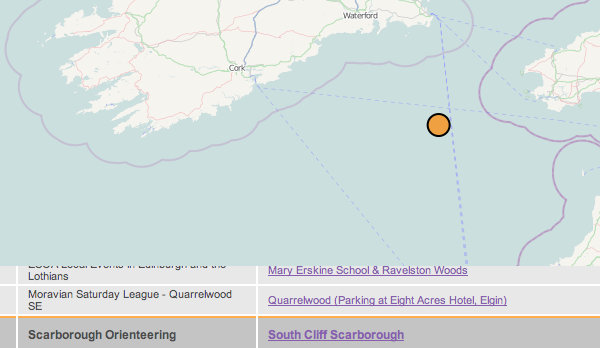
Not Scarborough…

The map remains subject to the quality of the data entered on the corresponding list – there is some limited tidying up of the data, but it’s difficult to correct grid references that result in events being in the sea – there’s currently one in the Irish Sea, as the event registrant entered “GR” as the grid reference letters, and this just so happens to be the location of the GR myriad. There is still work to be done on my new map, such as spotting obvious errors like this, guessing locations where a grid reference isn’t supplied, and perhaps including Northern Ireland’s events.

Incidentally, my original orienteering web map, which inspired my fixtures map, was one showing orienteering maps, it was written way back in August 2004, using a Flash mapping package by Map Bureau, with dots superimposed on top of a map pinched from Wikipedia. We’ve come a long way.
Categories
Orienteering

Nike+ SportWatch GPS Unveiled at CES

Nike’s unveiled a new GPS watch – the Nike+ SportWatch (press release) for runners, today at CES. It gets launched in the US and UK in April, and other countries soon after.

Currently Garmin has a near-monopoly on sophisticated personal GPS-based watches designed for sports users, with their Forerunner 205/305/405s. They are very popular with orienteers, as being able to record your route means you can graphically see mistakes made, and the different leg speed zones, during a race. Often, at orienteering events, a substantial portion of competitors will be wearing a Garmin Forerunner, so the introduction of a major new player in the field could be very interesting for the sport, and the new competition will hopefully bring prices down for the Garmins too.

The “killer feature” must be the integrated USB socket – no more balancing your GPS watch on a cradle and bringing along a USB cable – you can plug the Nike watch straight into a Mac or PC to download your run data. It also records your heart rate, but “separate heart rate monitor required”.

The GPS element of the Nike watch is powered by Tom Tom, Garmin’s main rivals in the personal GPS space.

Engadget has a hands-on video here.

Categories
Mashups OpenLayers OpenStreetMap

More Circles on a Map – Orienteering Fixtures

Five years ago, I created a mashup of forthcoming orienteering fixtures in Great Britain, as listed by the sport’s national governing body, British Orienteering, on its website. It was based on the Google Maps v2 API, and a regular scraping of the HTML on their website, and was a set of pins on a map, coloured by the number of weeks to the event. On clicking a pin, you got a popup balloon with details of the event, and a link to the organising club’s website. A postcode locator, based on data from the NPEMap project, was added, so you could focus on events in your local area. You could also filter out far away events.

A couple of years later, British Orienteering’s web developers added their own map to their website – Google Maps v2 API based, with pins coloured by the number of weeks to the event, and a popup balloon, a postcode search and distance filter etc etc… The Unique Selling Point of my fixtures map was lost.

So, when a rewrite of British Orienteering’s website just before Christmas broke my map, I took the opportunity to rewrite it, as a vacation project, using the technologies I’ve been using a lot in 2010 – namely OpenLayers, OpenStreetMap, OS OpenData and coloured vector circles. The map is bigger, brighter, and hopefully more useable than the official map and my previous version.

You can see the new map here – with a mass of dots representing forthcoming fixtures, and circles surrounding the “home” postcode, backed by OpenStreetMap, with the postcode locator based on CodePoint Open from Ordnance Survey OpenData. Only the locator uses a database, the rest of the webpage is constructed on-the-fly from a webpage regularly copied from the British Orienteering website.

Not Scarborough…

The map remains subject to the quality of the data entered on the corresponding list – there is some limited tidying up of the data, but it’s difficult to correct grid references that result in events being in the sea – there’s currently one in the Irish Sea, as the event registrant entered “GR” as the grid reference letters, and this just so happens to be the location of the GR myriad. There is still work to be done on my new map, such as spotting obvious errors like this, guessing locations where a grid reference isn’t supplied, and perhaps including Northern Ireland’s events.

Incidentally, my original orienteering web map, which inspired my fixtures map, was one showing orienteering maps, it was written way back in August 2004, using a Flash mapping package by Map Bureau, with dots superimposed on top of a map pinched from Wikipedia. We’ve come a long way.