Categories
CDRC London Technical

Big Data Here: The Code

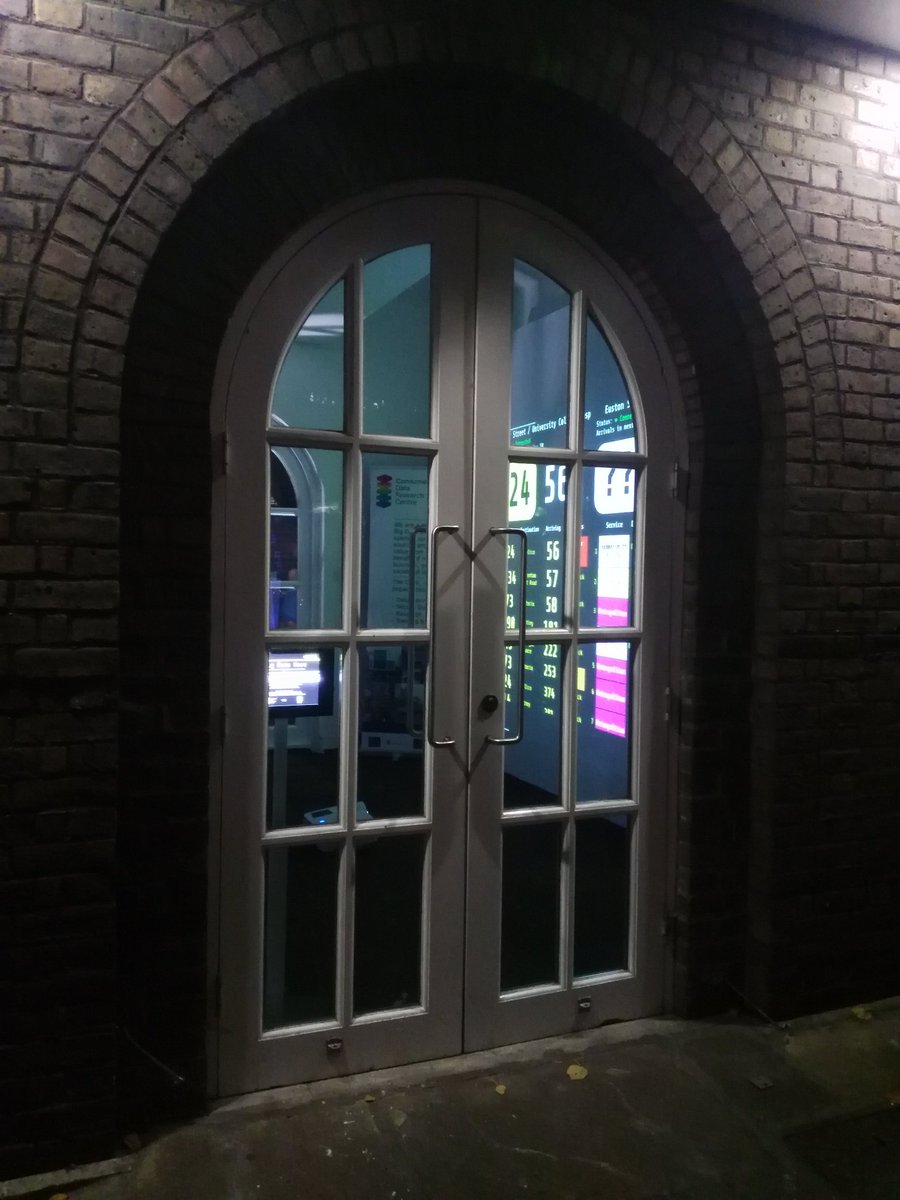
So Big Data Here, a little pop-up exhibition of hyperlocal data, has just closed, having run continuously from Tuesday evening to this morning, as part of Big Data Week. We had many people peering through the windows of the characterful North Lodge building beside UCL’s main entrance on Gower Street, particularly during the evening rush hour, when the main projection was obvious through the windows in the dark, and some interested visitors were also able to come inside the room itself and take a closer look during our open sessions on Wednesday, Thursday and Friday afternoons.

Thanks to the Centre for Advanced Spatial Analysis (CASA) for loaning the special floor-mounted projector and the iPad Wall, the Consumer Data Research Centre (CDRC) for arranging for the exhibition with UCL Events, Steven Gray for helping with the configuration and setup of the iPad Wall, Bala Soundararaj for creating visuals of footfall data for 4 of the 12 iPad Wall panels, Jeff for logistics help, Navta for publicity and Wen, Tian, Roberto, Bala and Sarah for helping with the open sessions and logistics.

The exhibition website is here.

I created three custom local data visualisations for the big screen that was the main exhibit in the pop-up. Each of these was shown for around 24 hours, but you can relive the experience on the comfort of your own computer:
bdh_buses

1. Arrival Board

View / Code

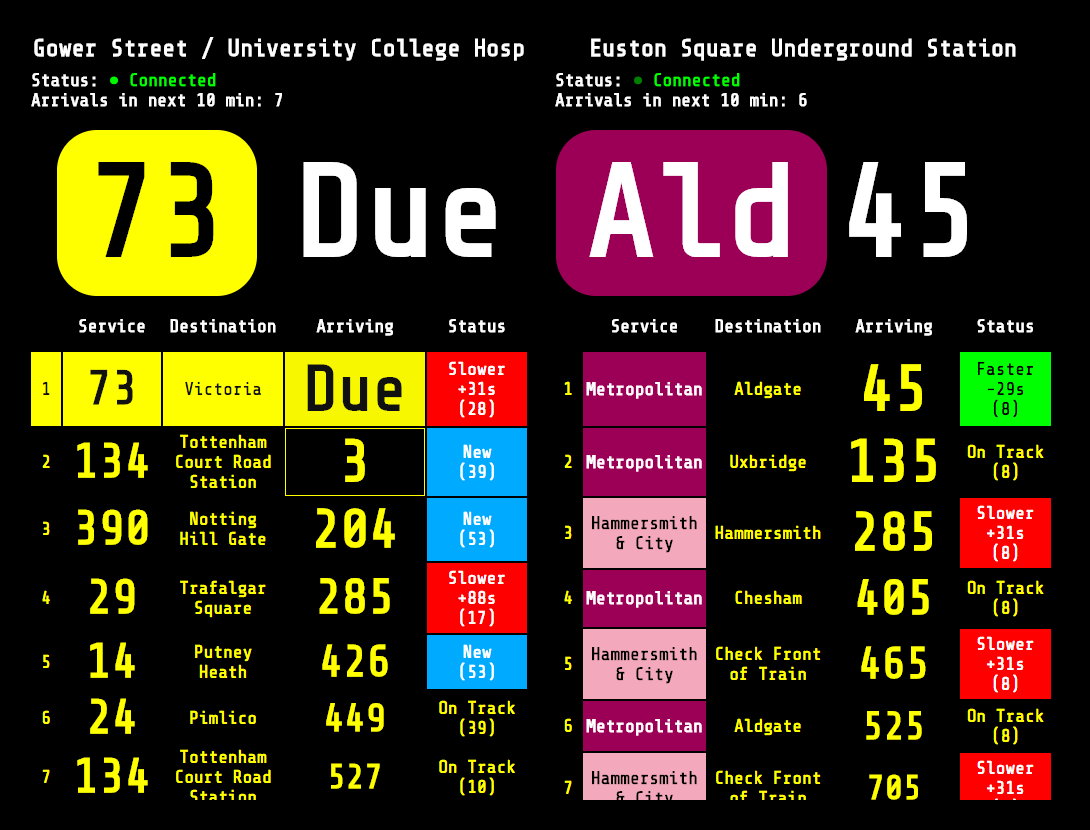
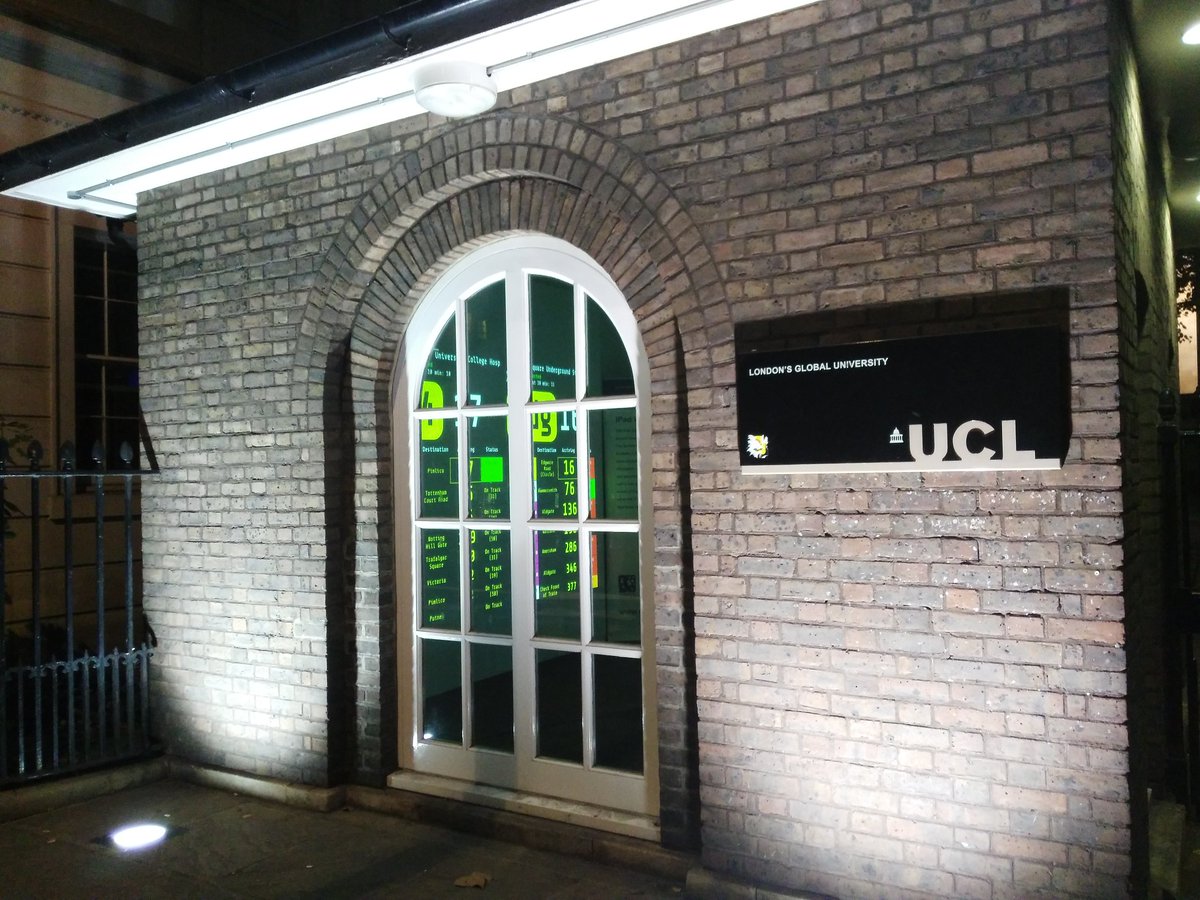
This was shown from Tuesday until Wednesday evening, and consisted of a live souped-up “countdown” board for the bus stop outside, alongside one for Euston Square tube station just up the road. Both bus stops and tube stations in London have predicted arrival information supplied by TfL through a “push” API. My code was based on a nice bit of sample code from GitHub, created by one of TfL’s developers. You can see the Arrival Board here or Download the code on Github. This is a slightly enhanced version that includes additional information (e.g. bus registration numbers) that I had to hide due to space constraints, during the exhibition.

Customisation: Note that you need to specify a Naptan ID on the URL to show your bus stop or tube station of choice. To find it out, go here, click “Buses” or “Tube…”, then select your route/line, then the stop/station. Once you are viewing the individual stop page, note the Naptan ID forms part of the URL – copy it and paste it into the Arrival Board URL. For example, the Naptan ID for this page is 940GZZLUBSC, so your Arrival Baord URL needs to be this.
bdh_traffic2

2. Traffic Cameras

View / Code

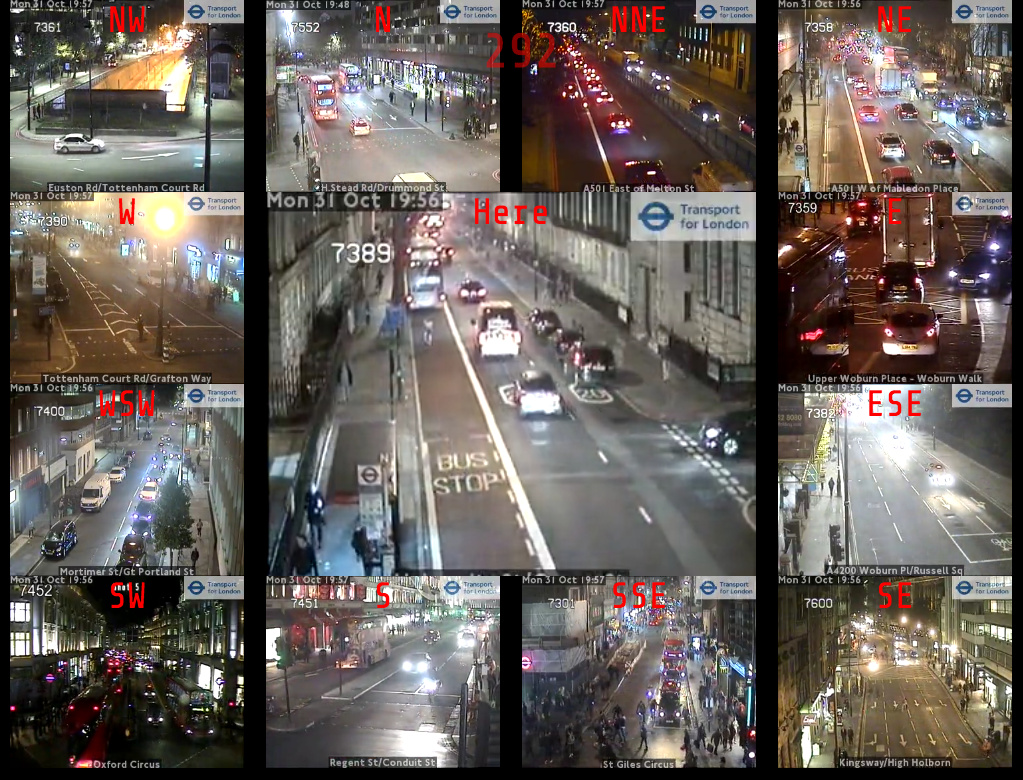
This was shown from Wednesday evening until Friday morning, and consisted of a looping video feed from the TfL traffic camera positioned right outside the North Lodge. The feed is a 10 second loop and is updated every five minutes. The exhibition version then had 12 other feeds, surrounding the main one and representing the nearest camera in each direction. The code is a slightly modified version of the London Panopticon which you can also get the code for on Github.

Customisation: You can specify a custom location by adding ?lat=X&lon=Y to the URL, using decimal coordinates – find these out from OpenStreetMap. (N.B. TfL has recently changed the way it makes available the list of traffic cameras, so the list used by London Panopticon may not be completely up-to-date.)
bdh_census

3. Census Numbers

View / Code

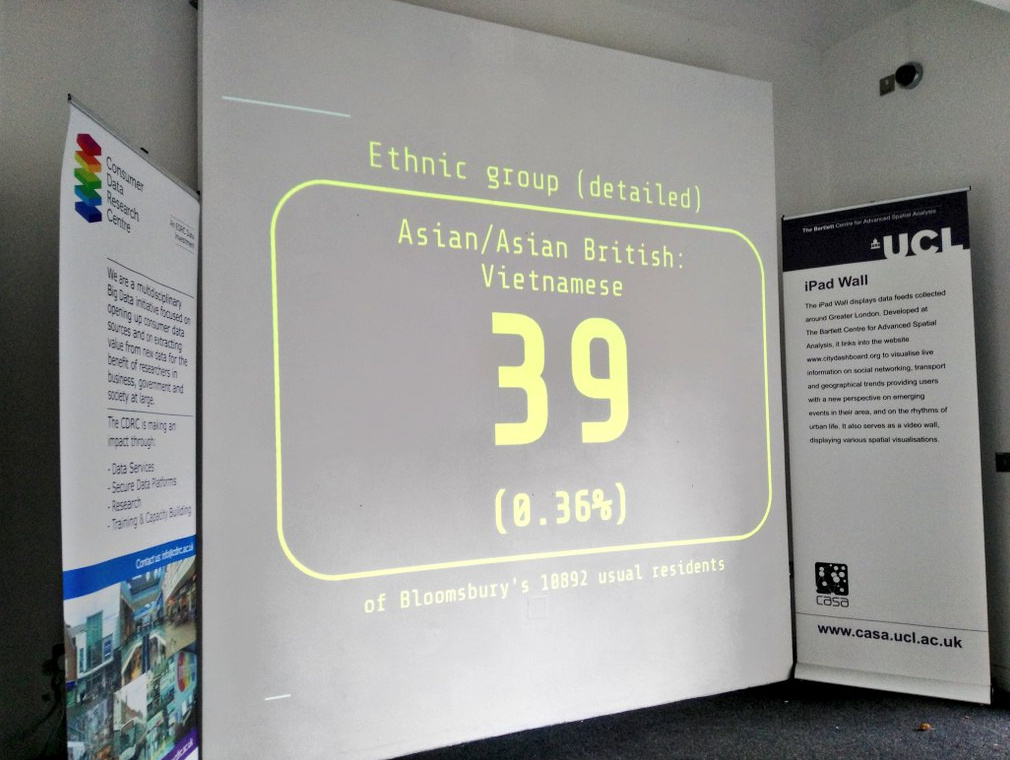
Finally, the screen showed randomly chosen statistical numbers, for the local Bloomsbury ward that UCL is in, from the 2011 Census. Again, you can see it in action here (wait 10 seconds for each change, or refresh), and download the code from GitHub.

Customisation: This one needs a file for each area it is used in and unfortunately I have, for now, only produced one for Bloomsbury. The data originally came, via the NOMIS download service, from the Office for National Statistics and is Crown Copyright.
bdh_traffic3

Categories
Data Graphics London

Big Data Here

9k-1

The Consumer Data Research Centre (CDRC) at UCL is organising a short pop-up exhibition on hyperlocal data: Big Data Here. The exhibition is taking place in North Lodge, the small building right beside UCL’s main entrance. The exhibition materials are supplied by the Centre for Advanced Spatial Analysis (CASA).

Inside, a big projection shows local digital information. What the screen shows will change daily between now and Friday, when the exhibition closes. Today it is showing a live to-the-second feed of bus arrivals at the bus stop outside the North Lodge, and tube train arrivals at Euston Square station just up the road. Watch the buses zip by as they flash up “Due” in big letters on the feed. Both of these are powered by Transport for London’s Unified Push API, and we are planning on publishing the visualisation online next week. Tomorrow will be showing a different local data feed, and then a final one on Friday.

cvimcbqwgaa4bkw

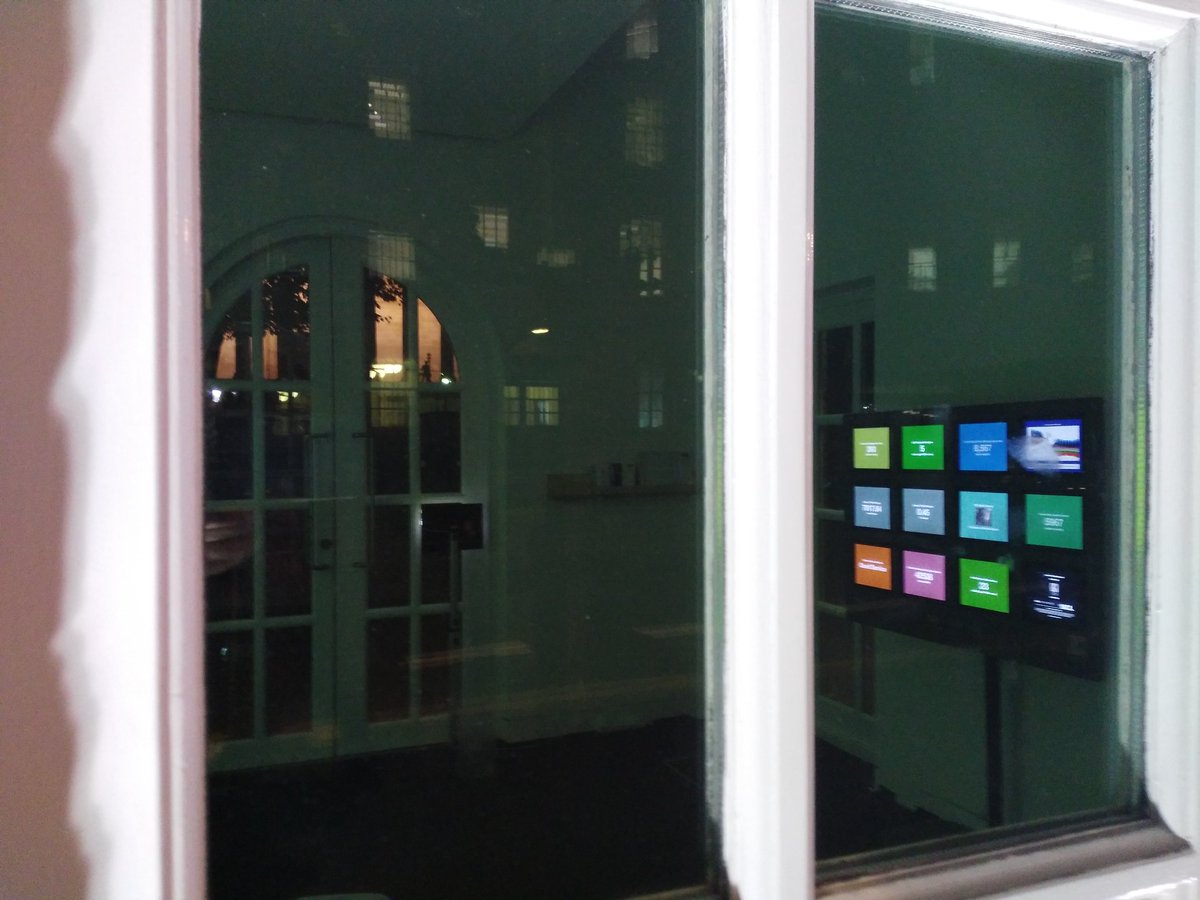
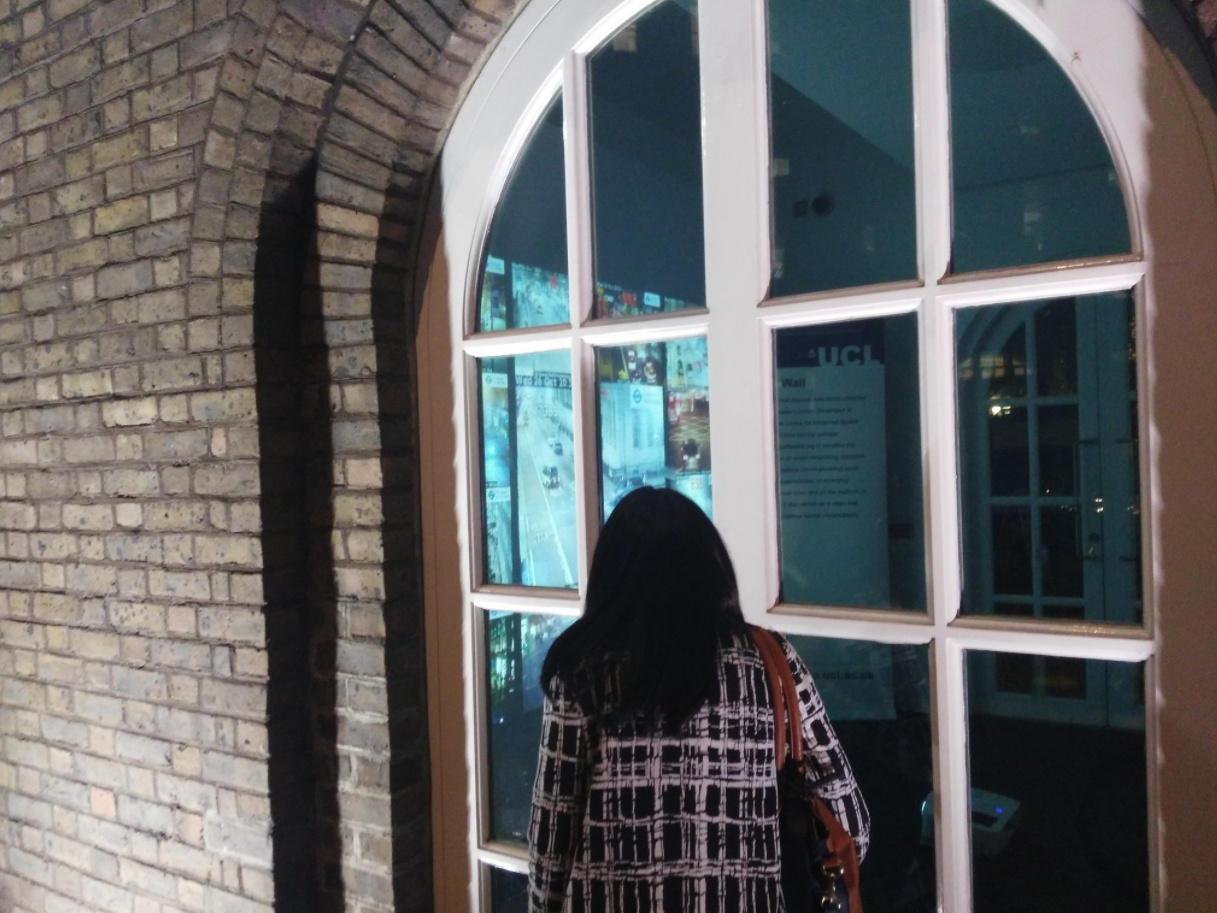
Opposite the projection is the iPad Wall. This was created by CASA a few years back by mounting a bank of iPads to a solid panel (above photo shows them in test mode) and allowing remote configuration and display. The wall has been adapted to show a number of metrics across its 12 panels. Four of these showcase footfall data collected by one of our data partners, and being used currently in CDRC Ph.D. research. The other panels show a mixture of air quality/pollutant measures, tube train numbers and trends, and traffic camera videos.

We hope that passersby will enjoy the exhibition visuals and use them to connect the real world with the digital space, a transposition of a digital data view onto the physical street space outside.

The exhibition runs 24 hours a day until Friday evening, with the doors open from noon until 3:30pm each day. The rest of the time, the visualisations will be visible through the North Lodge’s four windows. The exhibition is best viewed at night, where the data shines out of the window, spilling out onto the pavement and public space beyond:

2q

Big Data Here is taking place during Big Data Week 2016. Visit the exhibition website or just pop by UCL before Friday evening.

9k

cvmvee-xyaaxmep

Categories
London

Busiest Tube Station Times

chesham_max

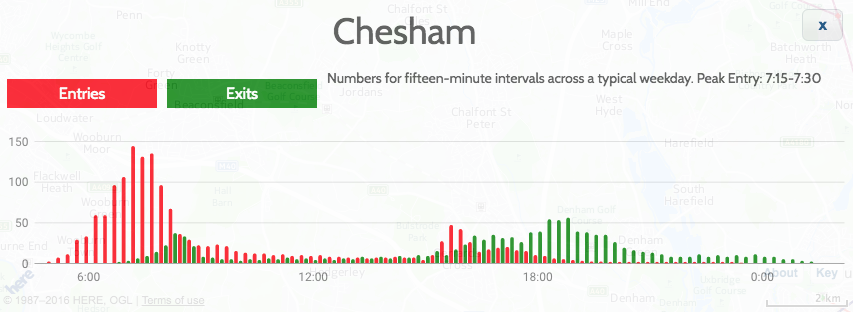
Here are the busiest Tube station quarter-hour periods, based on the Transport for London 2015 RODS data (modelled, based on typical autumn weekday), used in Tube Heartbeat, adding together entries, exits and interchange stats and excluding Kensington Olympia which does not have a frequent Tube service.

The main pattern shows that stations further out (map) from London’s main work areas (The West End, the City and Canary Wharf) have an earlier morning peak (or later evening peak), due to the journey taking longer and the tendency for many people to arrive at their work-end station at about the same time – just before 9am. A secondary effect is that stations which just act as simple commuter home and work portals, we would expect the usage to peak in the morning rush hour, rather than than evening one, as the morning rush hour is shorter and so the simple commuter flow is more concentrated. Therefore, stations which show a peak in the evening are often due to a combination of this simple commuter flow and an evening “going out” destination.

Station Peaks by Time of Day

7:15am-7:30am: Chesham [Zone 9]

7:30am-7:45am: Chalfont & Latimer [8], Epping [6]

7:45am-8:00am: Amersham [9], Chorleywood [7], Debden [6], Elm Park [6], Hillingdon [6], Hornchurch [6], Theydon Bois [6], Cockfosters [5], Pinner [5], South Ruislip [5], Stanmore [5], Mill Hill East [4], Chigwell [4], Grange Hill [4], Perivale [4],Kew Gardens [3/4], Wimbledon Park [3], Holland Park [2]

8:00am-8:15am: Alperton, Arnos Grove, Balham, Barking, Barkingside, Becontree, Buckhurst Hill, Canons Park, Chiswick Park, Clapham South, Colindale, Colliers Wood, Croxley, Dagenham East, Dagenham Heathway, Eastcote, East Putney, Edgware, Fairlop, Finchley Central, Gants Hill, Hainault, Harlesden, Harrow-on-the-Hill, Hatton Cross, High Barnet, Hounslow Central, Hounslow East, Hounslow West, Ickenham, Kenton, Kingsbury, Loughton, Moor Park, Morden, Neasden, Newbury Park, Northfields, North Harrow, Northolt, Northwick Park, Northwood, Northwood Hills, Oakwood, Osterley, Parsons Green, Preston Road, Ravenscourt Park, Rayners Lane, Redbridge, Rickmansworth, Roding Valley, Ruislip, Ruislip Gardens, Ruislip Manor, Seven Sisters, Snaresbrook, South Ealing, Southfields, Southgate, South Harrow, South Kenton, South Wimbledon, Stamford Brook, Sudbury Hill, Sudbury Town, Totteridge & Whetstone, Turnham Green, Upminster Bridge, Upney, Wanstead, Watford, West Acton, West Harrow, West Ruislip, Wimbledon, Woodford, Woodside Park

8:15am-8:30am: Acton Town, Archway, Arsenal, Blackhorse Road, Boston Manor, Bounds Green, Bow Road, Brent Cross, Brixton, Bromley-by-Bow, Burnt Oak, Canada Water, Canning Town, Dollis Hill, Ealing Broadway, Ealing Common, East Acton, East Finchley, Finchley Road, Finsbury Park, Fulham Broadway, Golders Green, Goldhawk Road, Hammersmith (H&C), Harrow & Wealdstone, Hendon Central, Highgate, Kensal Green, Kilburn, Kilburn Park, Leytonstone, Maida Vale, Manor House, North Acton, North Wembley, Park Royal, Plaistow, Putney Bridge, Queen’s Park, Shepherd’s Bush Market, St. John’s Wood, South Woodford, Swiss Cottage, Tooting Bec, Tooting Broadway, Tottenham Hale, Tufnell Park, Upton Park, Walthamstow Central, Warwick Avenue, Wembley Park, West Brompton, West Finchley, West Hampstead, Willesden Green, Wood Green

8:30am-8:45am: Baker Street, Bank/Monument, Barons Court, Belsize Park, Bermondsey, Caledonian Road, Canary Wharf, Chalk Farm, Earl’s Court, Edgware Road, Elephant & Castle, Euston, Hammersmith, Hampstead, Highbury & Islington, Holloway Road, Kennington, Kentish Town, Ladbroke Grove, Lancaster Gate, London Bridge, Marylebone, Mile End, Moorgate, Notting Hill Gate, Oval, Paddington, Pimlico, Richmond, Royal Oak, Stepney Green, Stockwell, Uxbridge, Vauxhall, Victoria, Westbourne Park, West Kensington, Westminster, Whitechapel

8:45am-9:00am: Barbican, Aldgate East, Blackfriars, Borough, Cannon Street, Chancery Lane, Edgware Road (Bakerloo), Euston Square, Farringdon, Great Portland Street, Latimer Road, Mansion House, Old Street, Regent’s Park, Southwark, St. James’s Park, St. Paul’s, Warren Street

3:30pm-3:45pm: North Ealing

5:00pm-5:15pm: Heathrow Terminal 5

5:15pm-5:30pm: Willesden Junction

5:30pm-5:45pm: Aldgate, Russell Square, South Kensington, West Ham, Heathrow Terminals 1 2 3, Heathrow Terminal 4

5:45pm-6:00pm: Bond Street, Embankment, Goodge Street, Green Park, Gunnersbury, Hanger Lane, Wood Lane, Holborn, King’s Cross St. Pancras, Knightsbridge, Lambeth North, Liverpool Street, Mornington Crescent, North Greenwich, Oxford Circus, Stonebridge Park, Charing Cross, Stratford, Temple, Tower Hill, Turnpike Lane, Upminster, Waterloo, White City

6:00pm-6:15pm: Angel, Camden Town, Covent Garden, East Ham, Gloucester Road, Greenford, High Street Kensington, Hyde Park Corner, Leicester Square, Leyton, Marble Arch, Piccadilly Circus, Queensway, Shepherd’s Bush, Sloane Square, Tottenham Court Road

6:15pm-6:30pm: Bayswater [1], Bethnal Green [2], Clapham Common [2], Clapham North [2], Queensbury [4], Wembley Central [4]

You can explore graphs of the flows, in detail, at Tube Heartbeat – just choose the station of your choice on the drop-down on the top right, or click on it on the map.

Six Rush Hours?

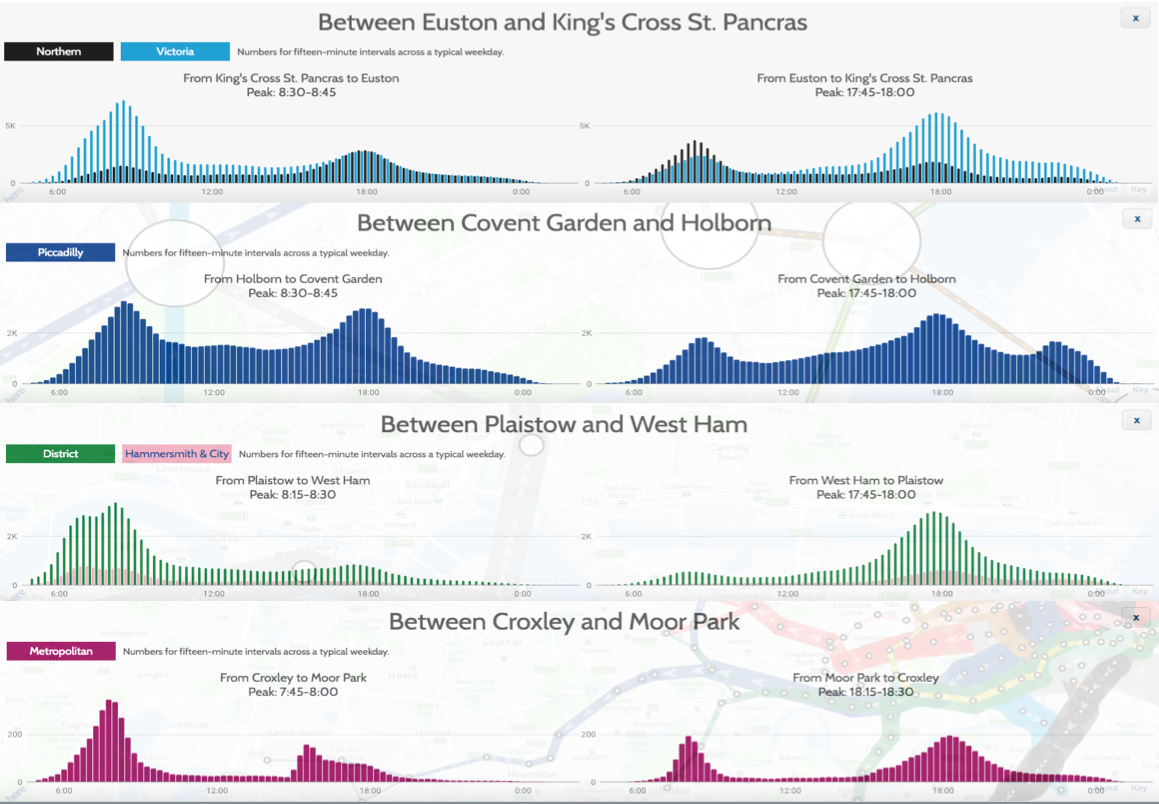
Interestingly, if you look at the flows between stations, you can actually see SIX rush hours each weekday (you can see five of them below by looking across these sample segment graphs):

fiverushhours

These are:

  • A early morning peak, 7-8am. This is distinct from the main morning peak, and can be seen certain segments in east London, particularly on the District line near Plaistow, where the two morning peaks are an hour apart, with a noticeable dip in flow between the two. This may reflect the workforce for some traditional industries with 8am-4pm historical or shift-based working hours.
  • The main morning rush hour that almost all stations and line segments see – 7:30am-9am. Some of the more outlying stations (Zones 5-9) see their peak for this rush hour earlier than 8am, as it takes a while to get into the centre of London. You can see this is not the 7-8am peak above, by “tracing” the ripple through the network towards central London.
  • School home-time at roughly 3-4pm. Mainly affects some smaller, outer London stations, particularly in the north-west, for example Moor Park.
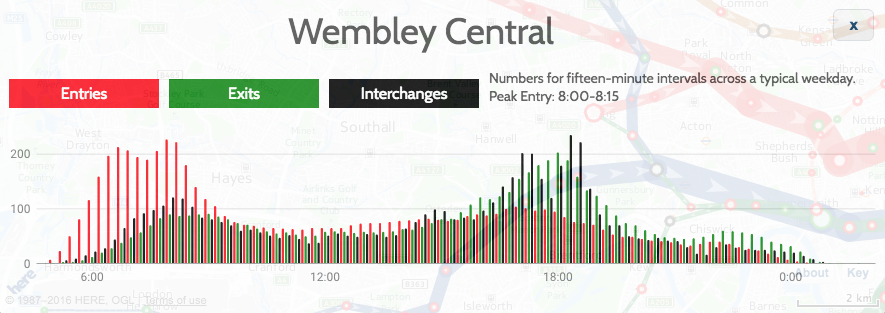
  • A corresponding 4-5pm peak for shift workers who started at 8am. Only a few links show this, such as Wembley Central in north-west London. The evening rush hours are less “compressed” than the morning ones so it is generally harder to distinguish between this one and the next one.
  • The main evening rush hour, 5-7pm.
  • Theatreland end-of-show rush hour, 10-11pm. Noticeable around Leicester Square, Covent Garden and Holborn. Some other areas, with established night-time economies, may also see a slight peak around this time.

You can also see 3+ rush hours in some of the stations, such as Wembley Central, which shows all six:

wembley_max