I’m up in Oban in the Western Highlands for the next week or so, competing in the Scottish 6 Days international orienteering races. I’ll be cycling between the venues each day – with a single gear, as both my shifters have failed in the last couple of weeks. I was a bit worried about the hills on the roads around there – it is the Highlands after all, but my parents have found a book that should solve that problem. It is “The Contour Road Book of Scotland” and it is an original copy, published in 1896. You can see a slightly newer version (1898) here on the Internet Archive (see links on left) although this version misses out a few of the earlier pages.
The book details all the major roads in Scotland (115 years ago – so no motorways or city bypasses!) with a subjective description of the road, a list of key gradients and sights, and an altitude profile. The Scottish Mountaineering Club reviewed it in their fourth edition (September 1896) and were encouraged that it could be used to relate cycling and mountaineering.
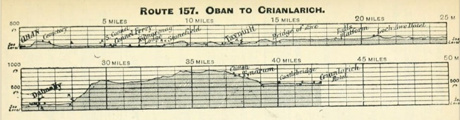
I was pleased to see route 157 (Oban to Crianlarich) is “Class II [an ordinary main road]. The first 8 miles of the road are good.” Thankfully I’m not going further along it though, as it continues: “Thence to Tyndrum is a fearful road – grass and loose stones”. The book suggests a 1/13 gradient 3/4 mile from Oban will be my main concern, and that I’ll encounter Dunstaffnage Castle as a “Principle Object of Interest” after 3 miles. The section concludes with the encouraging comment that “The scenery on this road is very fine”.
Here is a copy of the accompanying altitude profile, from the 1898 online version on the Internet Archive:
Picking out one more route – 298 (Inverness to Fort Augustus), the guide writes that “the road gets worse and worse, and after Whitebridge is a loose mass of stones, with very steep hills… at times the surface… is little better than a watercourse… These hills of are course highly dangerous… the scenery about Foyers is very fine”. I cycled this route on Day 2 of my John O’Groats to London challenge and can indeed vouch for the scenery at Foyers.
There are some evocative advertisements from the time – one for the Cockburn Hotel which is “adjoining Waverley Station” in Edinburgh, and offers “Passenger Lift” and “Electric Light” but “No Intoxicating Drinks”. The Pneumatic Brake Co Ltd of Manchester has “Tips to Tourists” where it quotes the book it is in – “Hills are not generally regarded as dangerous to descent until they are 1 in 15, and with anything steeper the danger increases” – by adding “If you desire to desire to descend hills of the above description with ease, safety and comfort, send your Cycle to the nearest Cycle Agent to be fitted with a Pneumatic Brake which can be done in a few minutes”. Good to know.
There is also a section with maps of Scotland, the most eye-catching difference is there were many more railway lines in Scotland 115 years ago than there are now…




 On the Thursday evening that we arrived,
  Our final trip was more ambitious – four of us OSMers headed right through the old city, past the cathedral, and eventually into the more commercial part of the city, then underneath the huge Praterstern station and right up to the Danube. Here, there is a dedicated cycle track underneath the road bridge. The bridge is however quite a way beyond the area of docking stations, so the other cyclists around were on more serious bikes.

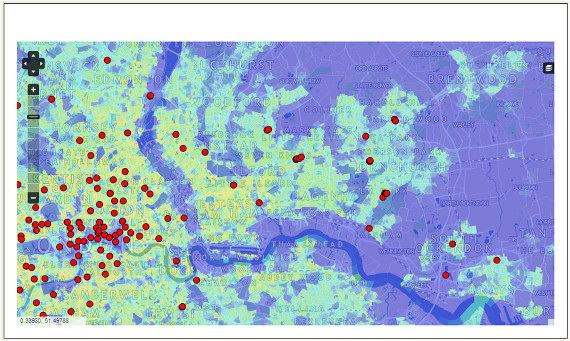
 Muki Haklay gave an overview of his team’s completeness analysis for the UK OSM dataset over the years. We used to say we “are good enough”. Now we can say that, subject to qualifications, we are “as good as” some traditional datasets. There was also some similar research presented by Heidelberg University, which used hexagonal cartograms, which was an interesting change from grid squares. I should also mention Steve Coast’s keynote, which was a frank statement of the current state of play of the project – good in many places, but problems with the Australian community feeling disengaged and looking to split from the project were clearly top of his mind.
 The social side of the conference was excellent. Plenty of breaks for networking, and a conference dinner on the Friday night. This involved everyone getting a couple of specially hired 1920s wooden trams (or “Bims” after the sound their bells make) to a suburb of Vienna – via the grand ring-road, past the various palaces and other grand buildings – whereupon we took over most of a restaurant for an Austrian feast of Wiener schnitzel, meat loaf, sauerkraut, picked cucumber, and a dessert of apple strudel. A few resturant-brewery combinations were also visited during the trip – along with some most refreshing lagers, served in proper glasses with handles that make a lovely “clonk”. Vienna was very warm indeed, with a thunderstorm on the first night. It was also eerily quiet – the city is quite grand and spaced out, plus maybe many of the locals were on holiday to the mountains. Certainly the people we met were friendly. I should mention specially the conference organisers, which were flawless and ensured everyone was in the right place at the right time! The organisation of the conference and social events appear to go off without a hitch.
