Categories
London

Working Lines

workinglines_northern

As a followup to Tube Tongues I’ve published Working Lines which is exactly the same concept, except it looks at the occupation statistics from the 2011 census, and shows the most popular occupation by tube station. Again, lots of spatial clustering of results, and some interesting trends come out – for example, the prevalence of teachers in Zones 3-4, that there is a stop on the central line in north-east London which serves a lot of taxi drivers, and that bodyguards really are a big business for serving the rich and famous around Knightsbridge.

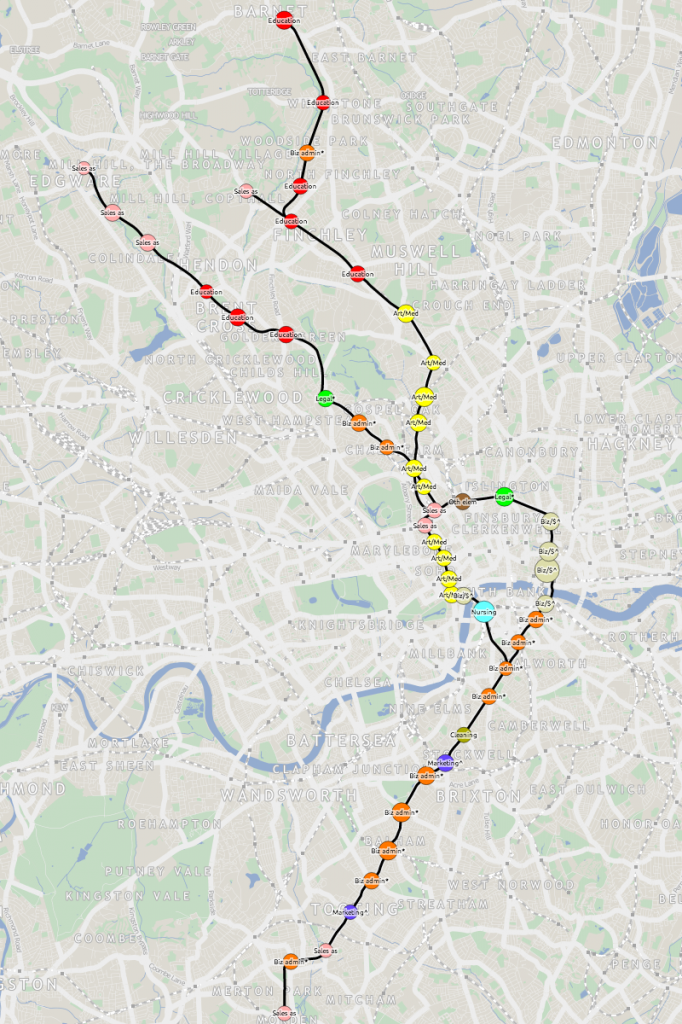
The northern line (above) stands out as one that serves a community of artists (to the north) and less excitingly a community of business administrators (to the south). Tottenham/Seven Sisters has a predominance of cleaners, and unsurprisingly perhaps plenty of travel agents live near Heathrow. I never knew that the western branch of the central line, towards West Ruislip, was so popular with construction workers. Etc etc.

Only the actively working population is included, rather than the full population of each area. This makes the numbers included in each buffer smaller, so I’ve upped the lower limit to the greater of 3% and 30 people, to cut down on small-number noise and minimise the effect of any statistical record swapping.

Categories
Data Graphics London

Tube Tongues

tubetongues

I’ve extended my map of tube journeys and busy stations (previous article here) to add in an interesting metric from the 2011 census – that of the second most commonly spoken language (after English) that people who live nearby speak. To do this I’ve analysed all “output areas” which wholly or partly lie within 200m radius of the tube station centroid, and looked at the census aggregate data for the metric – which was a new one, added for the most recent census.

See the new map here.
Also available as an A2 print.
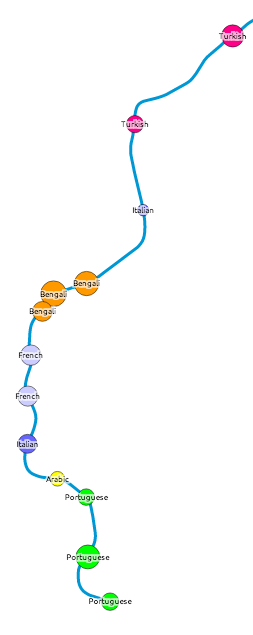
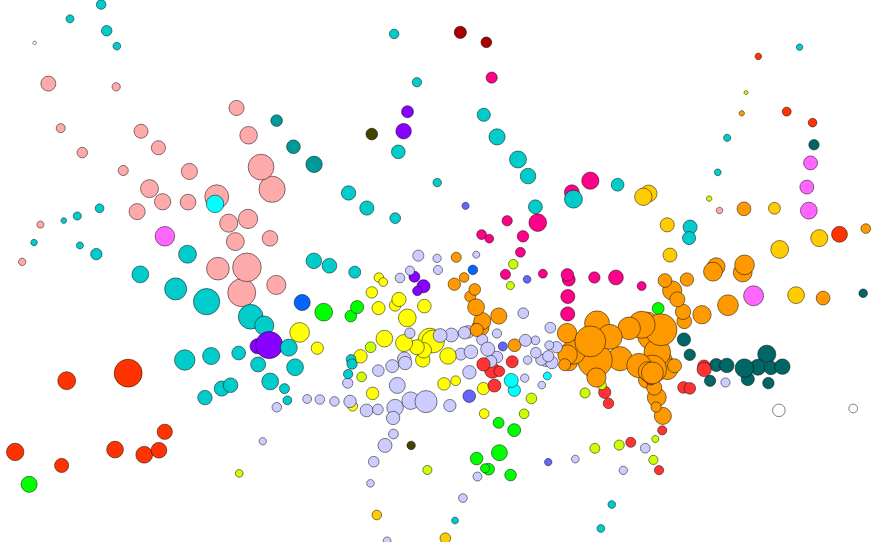
tubetongues_vicEach tube station has a circle coloured by, after English, the language most spoken by locals. The area of the circle is proportional to the percentage that speak this language – so a circle where 10% of local people primarily speak French will be larger (and a different colour) than a circle where 5% of people primarily speak Spanish.

Language correlates well with some ethnicities (e.g. South Asian) but not others (e.g. African), in London. So some familiar patterns appear – e.g. a popular, and uniform, second language appearing at almost all Tower Hamlets stations. Remember, the map is showing language, not origin – so many of the “Portuguese” speakers, for instance, may be of Brazilian origin.

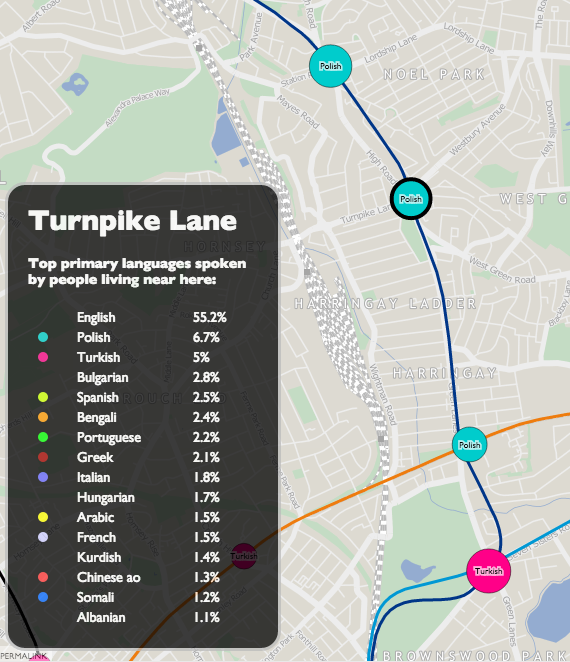
Click on each station name to see the other languages spoken locally – where at least 1% of local speakers registered them in the census. There is a minimum of 10 people to minimise small number “noise” for tube stations in commercial/industrial areas. In some very mono-linguistic areas of London (typically in Zone 6 and beyond the GLA limits) this means there are no significant second languages, so I’ve included just the second one and no more, even where it is below 1% and/or 10 people.

This measure reveals the most linguistically diverse tube station to be Turnpike Lane on the Piccadilly Line in north-east London, which has 16 languages spoken by more than 1% of the population there, closely followed by Pudding Mill Lane with 15 (though this area has a low population so the confidence is lower). By contrast, almost 98% of people living near Theydon Bois, on the Central Line, speak English as their primary language. English is the most commonly spoken language at every tube station, although at five stations – Southall, Alperton, Wembley Central, Upton Park and East Ham – the proportion is below 50%.
turnpikelane

A revealing map, and I will be looking at some other census aggregate tables to see if others lend themselves well to being visualised in this way.

I’ve also included DLR, Overground, Tramlink, Cable Car and the forthcoming Crossrail stations on the map. Crossrail may not be coming until 2018 but it’s very much making its mark on London, with various large station excavations around the capital.

The idea/methodology is similar to that used by Dr Cheshire for Lives on the Line. The metric was first highlighted by an interesting map, Second Languages, created by Neal Hudson. The map Twitter Tongues also gave me the idea of colour coding dots by language.

One quirk is that speakers of Chinese languages regularly appear on the map at many stations, but show as “Chinese ao” (all other) rather than Cantonese, whereas actually in practice, the Chinese community do mainly speak Cantonese (Yue) in London. This is likely a quirk of the way the question was asked and/or the aggregate data compiled. Chinese ao appears as a small percentage right across London, perhaps due to the traditional desire for Chinese restaurant owners to disperse well to serve the whole capital? [Update – See the comments below for an alternative viewpoint.]

The TfL lines (underground, DLR etc), station locations and names all come from OpenStreetMap data. I’ve put the collated, tidyed and simplified data, that appears on the map, as GeoJSON files on GitHub – see tfl_lines.json and tfl_stations.json. The files are CC-By-NC, licensing information is here.
Categories
Munros

A Trio of Munros in the Ben Alder Forest

IMG_1211

I climbed three Munros in the Ben Alder Forest area yesterday. This is the eastmost part of large tract of wilderness in the Scottish Highlands, stretching from Loch Ericht (between Dalwhinnie and Rannoch) all the way over to Glen Nevis (near Fort William). No public roads cross the area, and just one railway line, the West Highland Line. Ben Alder itself is a Munro of considerable bulk and height (1148m), it is hard to get to, requiring a long walk eastwards from Corrour station, northwards from Loch Rannoch or southwards from Dalwhinnie. I took the last option, taking advantage of a newly upgraded estate road to cycle the first 14km of the route to Loch Pattack (450m elevation), which took around 50 minutes – the well packed track generally passable on my road bike, apart from a sandy section near the end.

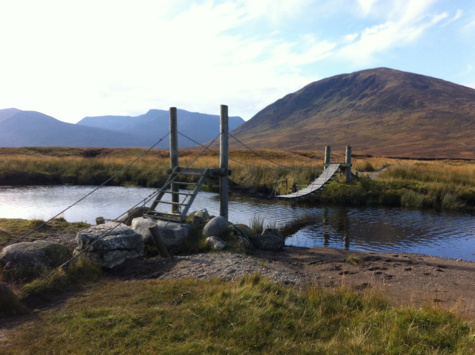
Shortly after crossing a wobbly suspension footbridge (pic above) across the loch inflow, I left the bike and climbed onto and up the easy-sloping ridge of Carn Dearg (1034m) from where there were fine views, both to Ben Alder and more immediately the Lancet Edge, a sharply pyramidal ridge leading up to another Munro I had climbed a few years before. I dropped down below the Lancet Edge, traversing a corrie and a valley at 600m before climbing up 100m to the Long Leachas. This is one of a number of ridges leading onto Ben Alder and it is in a spectacular location. The ridge offers easy scrambling, always with a bypass path. It is scenic and so makes the climb up to 1050m almost effortless. Near the top, it narrows, and keeping to the crest of the ridge offers numerous short and easy scambles over various boulders. From the top of the ridge, it is a 1.5km walk across the plateau to the summit of Ben Alder itself. Just below the summit lies the ruins of a small house – built by the team of the original Ordnance Survey surveying expeditions. Shortly after is a small lochan – at 1100m altitude, presumably one of the highest bodies of water in the UK.

IMG_1235

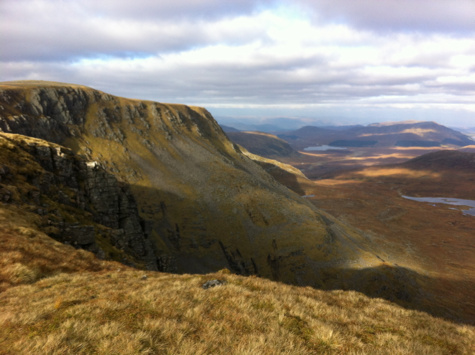
The best views are from the ridge following on from the summit (see pic above), particularly looking north down the cliffs to a large loch and over to the Monadhliath Mountains. Looking the other way, Loch Ossian, with its wonderfully remote youth hostel, is also visible.

It is best not to follow the ridge eastwards too far from Ben Alder’s summit, as it curves around to the north and then ends in cliffs on three sides. So I came off the ridge early, aiming for the high bealach (840m) and then it was a quick ascent up Beinn Bheoil (1019m), the last of the three. There is a small top just to the right, on the way up, that has a fine view over Loch Ericht – the loch is a reservoir, dammed at both ends as it crosses over Scotland’s east/west watershed.

After Beinn Bheoil, I continue northwards along the largely flat and easy ridge, then coming off it to the left and hitting a well made stalkers’ path, that leads down to the river, to a bridge across it near Culra Bothy (now closed) and finally back to Loch Pattack and my bike, exactly six hours after I left. I’d walked 22km and climbed 1450m. The return along the estate road, to catch the evening train home, was done with care, as it was by now twilight.

Route.